
Spiorad Àird nam Murchan XIV-Bourblaige: the glen that remembers

Spiorad Àird nam Murchan XIV —
Bourblaige: the glen that remembers
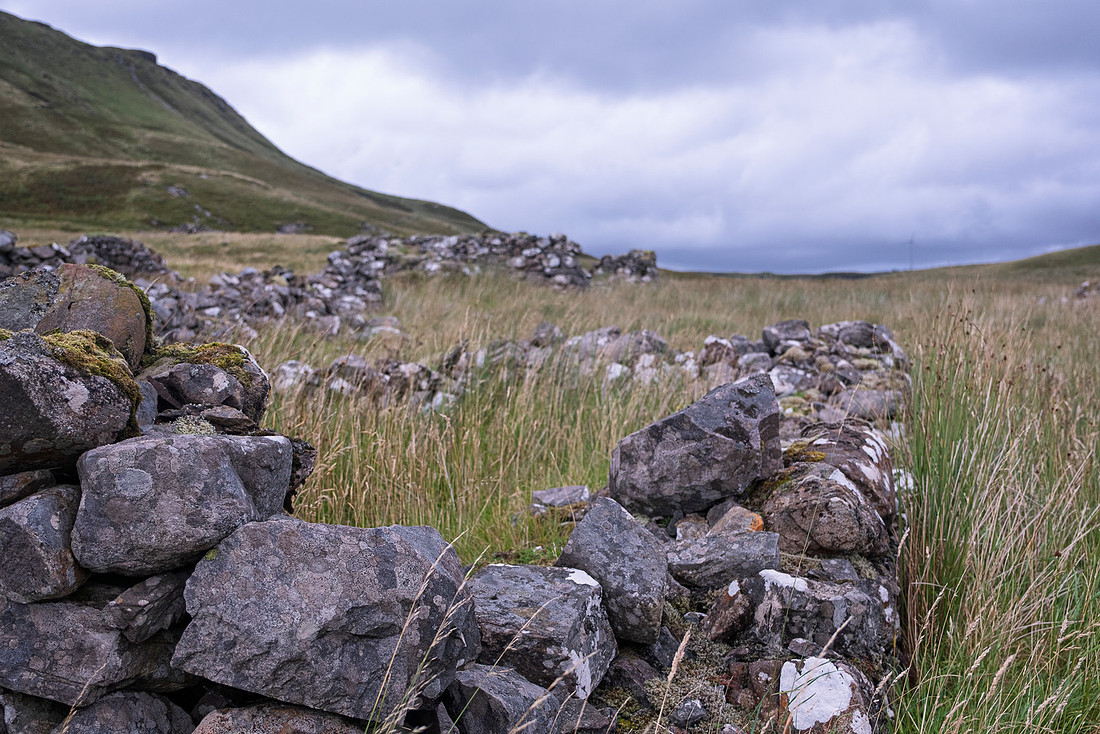

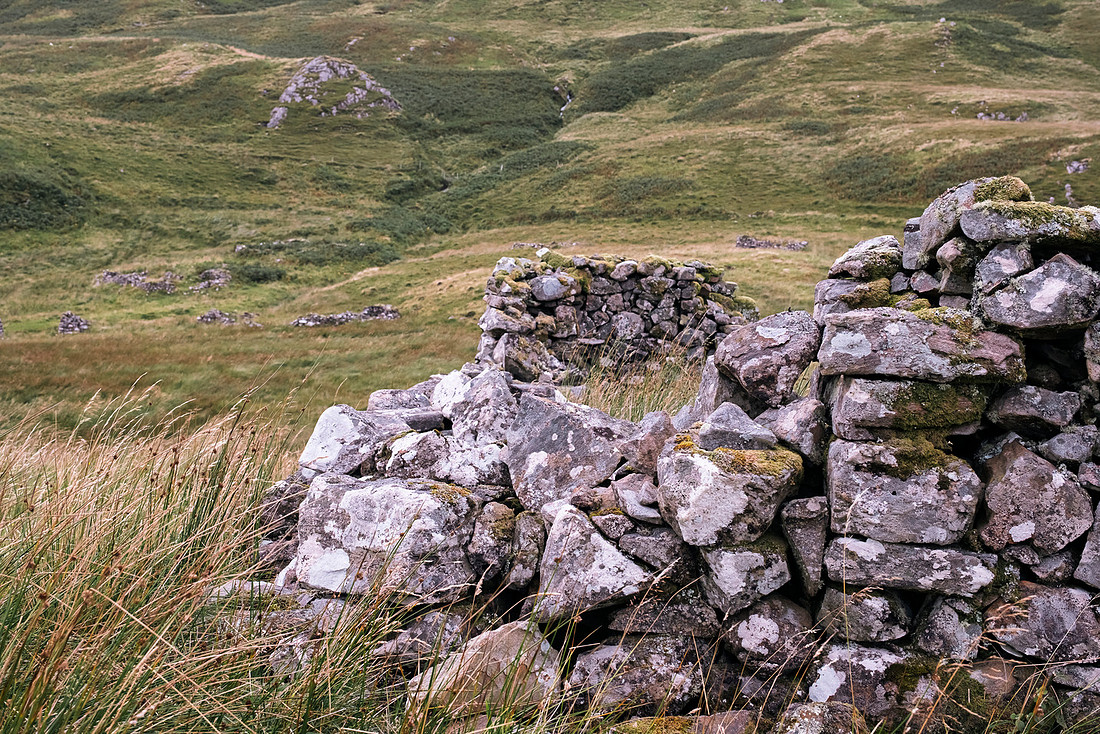
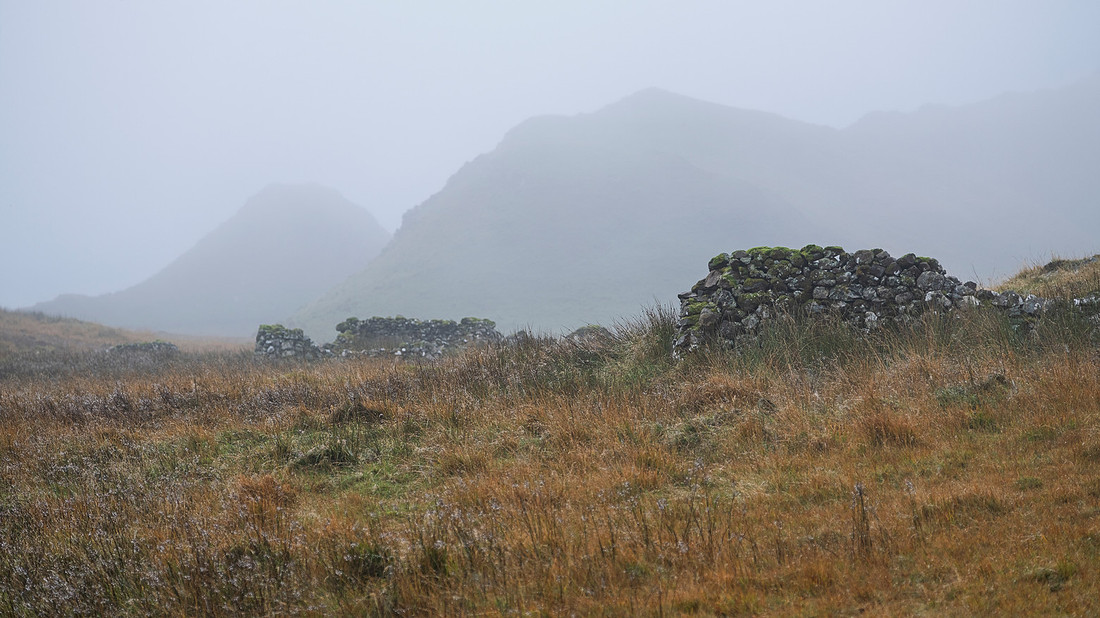
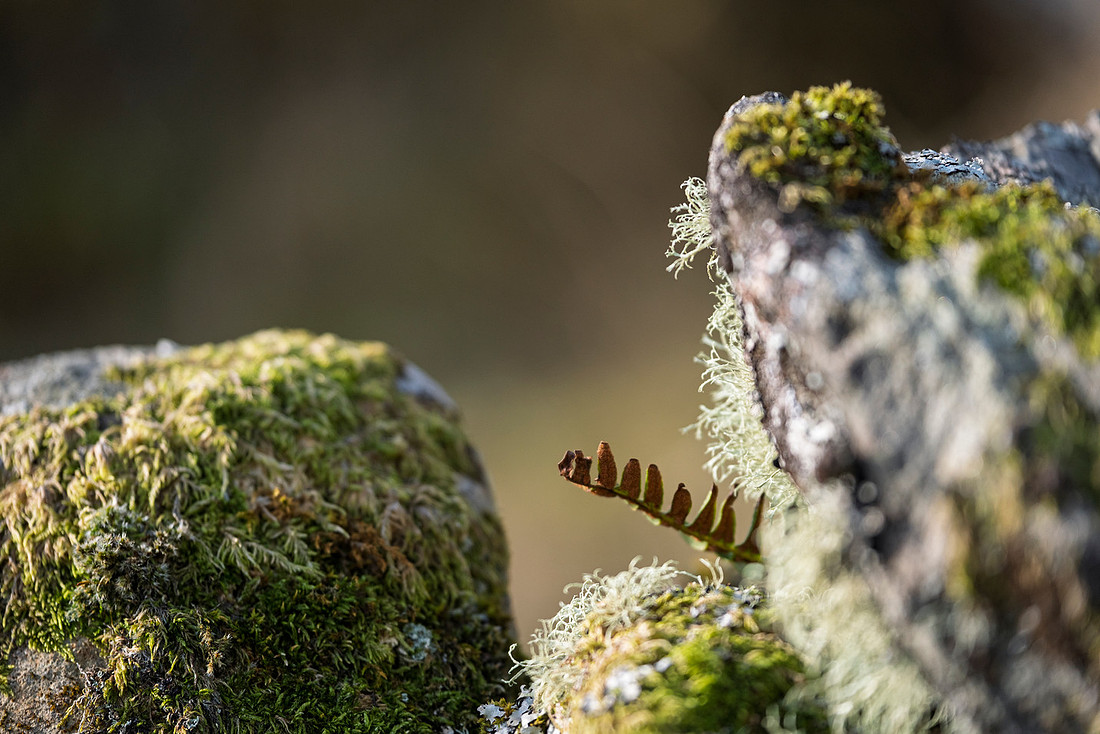
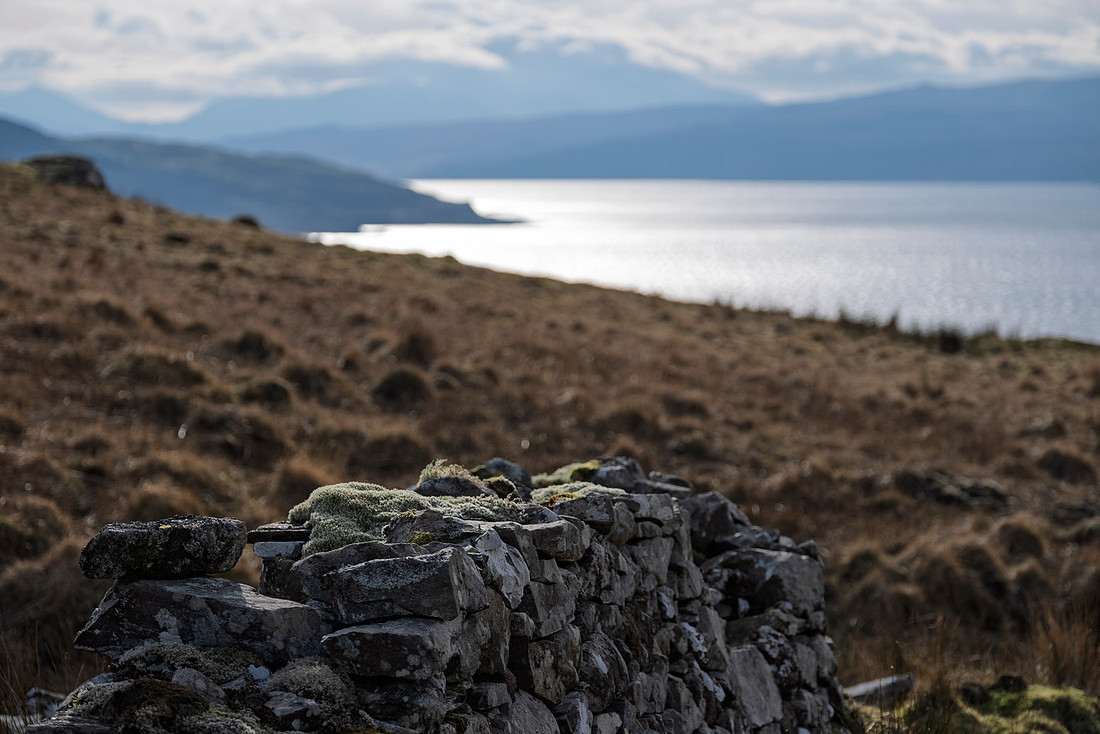
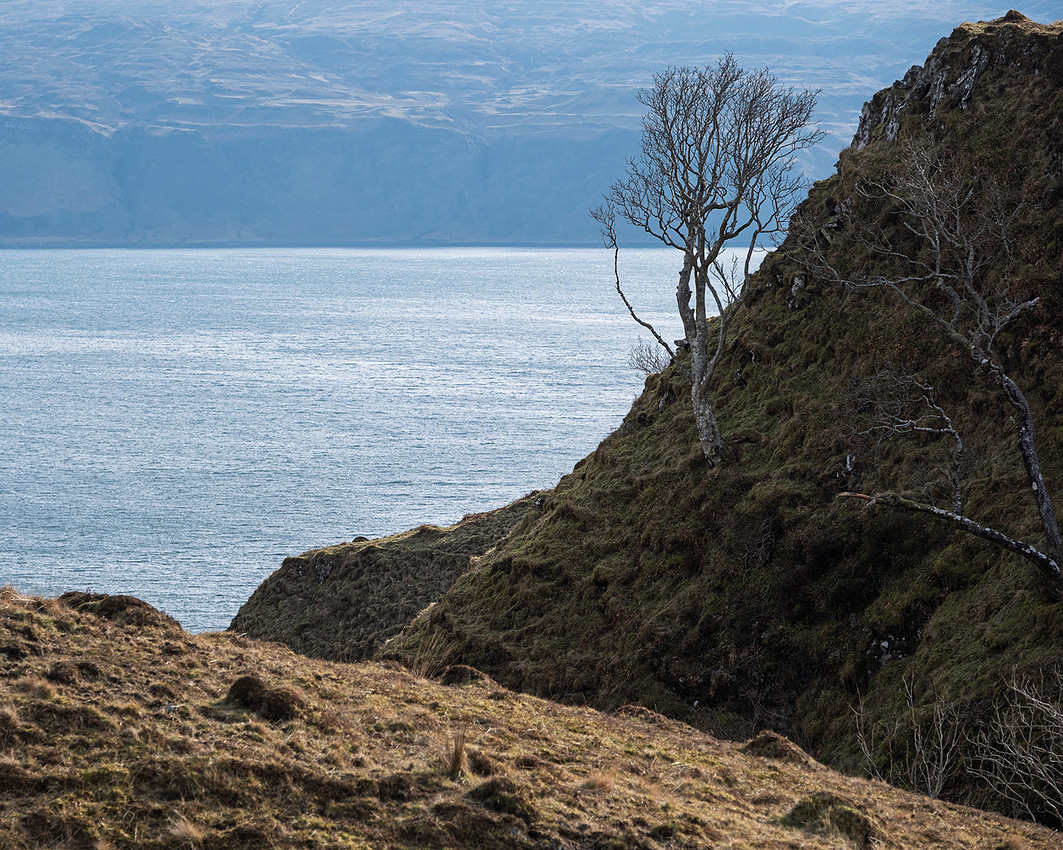
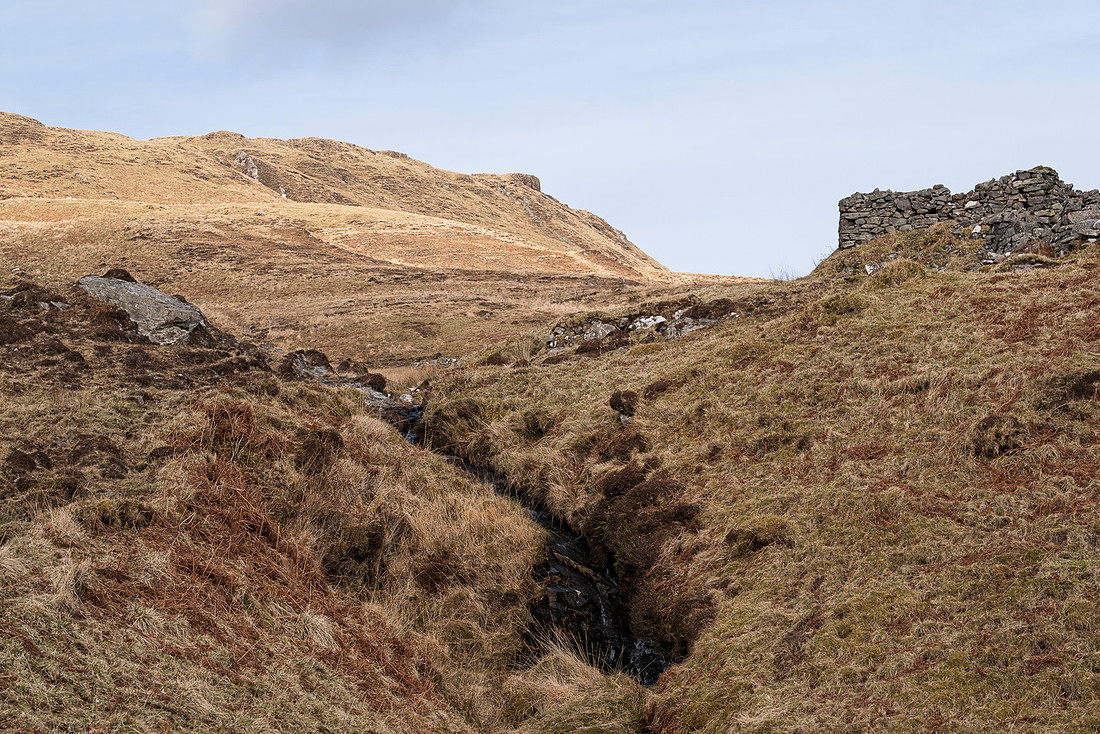
The path to Bourblaige lifts through bracken and wet grass until the ground opens like a bowl beneath the steep shoulder of Ben Hiant. A small burn stitches light through the hollow. Wind combs the heather, turning its nap the wrong way and back again. A rook of cloud leans over the Sound of Mull; Morvern and Mull rest beyond as if set there to steady the horizon. Here the air is felt as much as breathed. Stones stand where hands once placed them, wall-topped with moss, their lime and lichen threaded with silver. At first, the hush seems simple weather. Then it thickens—as if the glen is holding its own breath, asking for yours in return. In such moments, Bourblaige is unmistakably a thin place: a threshold where time folds, history presses close, and the living feel the nearness of the lives that went before. Scholars and practitioners in Celtic Christian traditions have long used “thin place” to name sites where the boundary between the earthly and the divine feels briefly permeable, an old notion renewed by places like Iona and framed by contemporary writers as liminal spaces of encounter and transformation.
The lie of the land
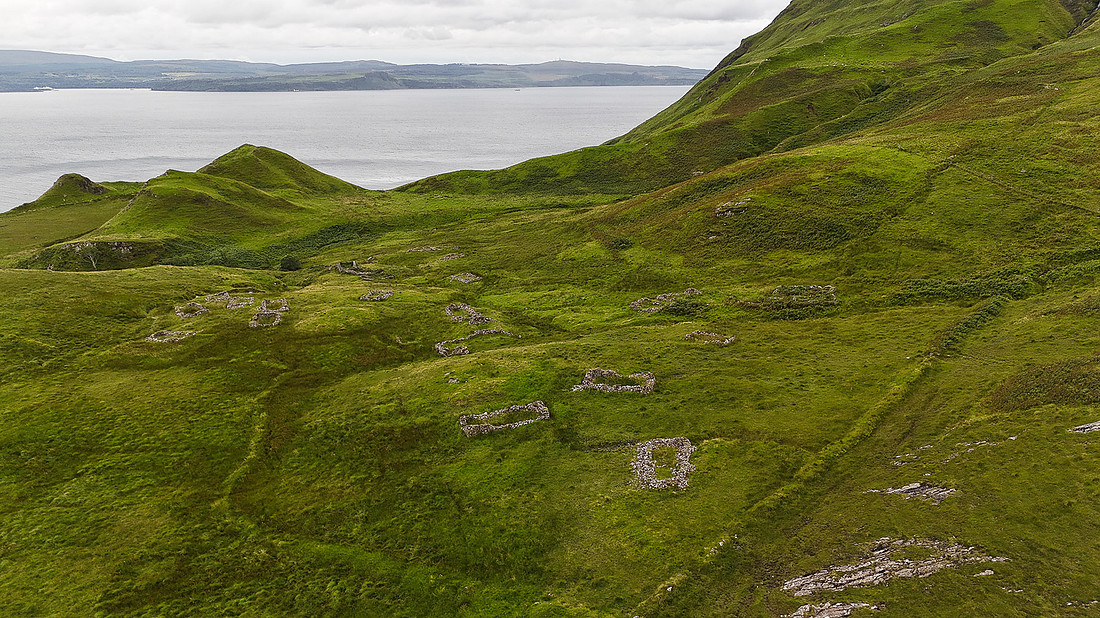
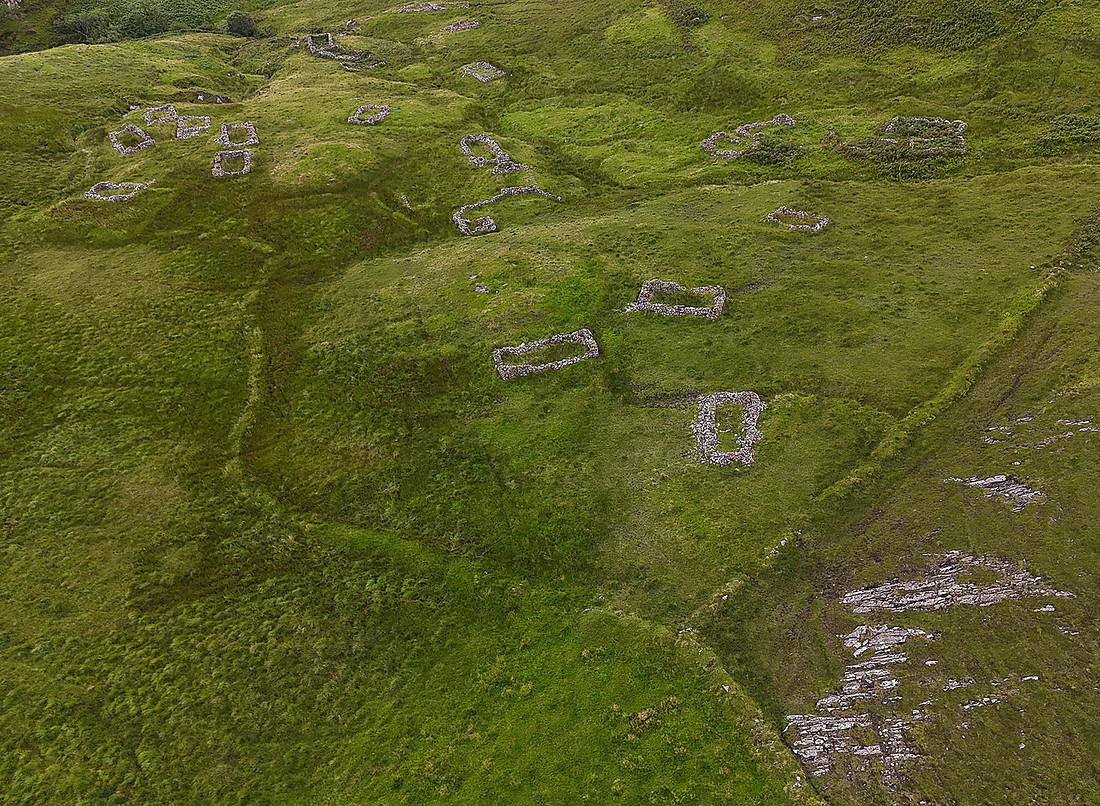
Bourblaige lies on the south‑east flank of Ben Hiant, in a wide, sheltered bowl between Camas nan Geall and MacLean’s Nose. The village’s footprint—about three dozen roofless structures, with enclosures, field systems, rig-and-furrow and a bounding head‑dyke—spreads over roughly 400 by 300 metres between 100 and 150 metres above sea level. Historic Environment Scotland has scheduled the settlement (SM6178) for its national importance: the buildings’ preservation and “complex architectural information” speak with unusual clarity to post‑medieval community life in the West Highlands.
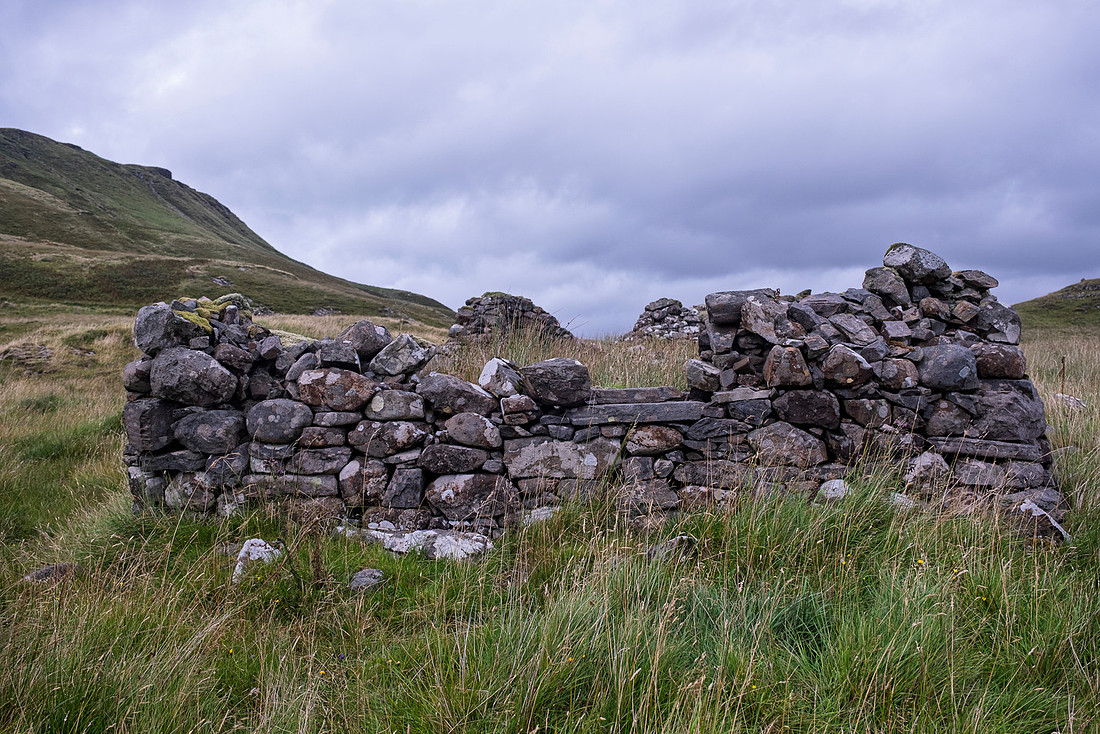
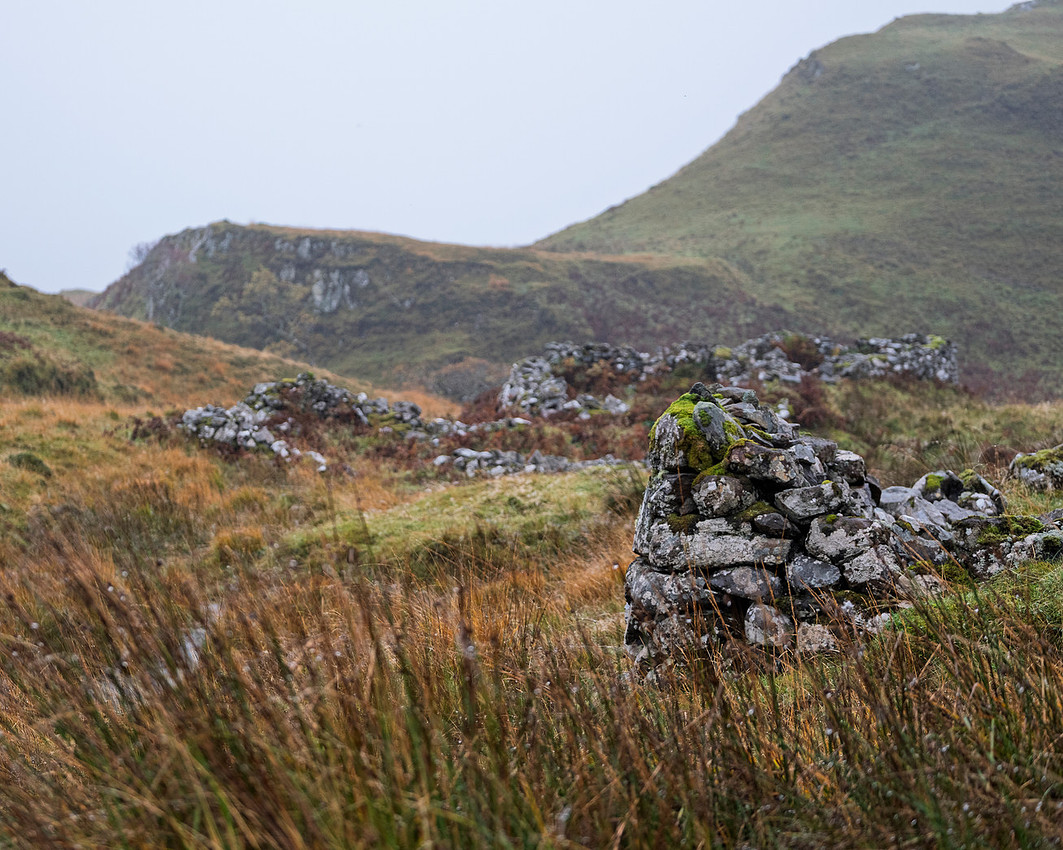
The site’s architecture is legible even now: drystone walls still stand to one or two metres, oblong plans mostly with rounded corners, many cruck-framed and hip‑roofed in their time. Several house clusters have small attached kail‑yards; isolated buildings likely belonged to cottars; a kiln‑barn stands among them; the infield is scored with rigs. Collectively, these fragments constitute a township rather than a scattering, the remains of a coherent social fabric whose patterns of labour and kinship are written into the ground.
Walkers who come in by the track often note how intact the place feels—“frozen in time to 1828,” as one local heritage account puts it. It helps that Bourblaige’s stones do not appear to have been quarried for later buildings; unlike neighbouring Tornamona, the village wasn’t reworked as a fank or reused as a stock‑gathering point. The atmosphere of an “intact village” persists—shells of houses, yes, but a plan you can still inhabit with your body.
A village cleared
In 1828 the village was forcibly cleared along with other clachans on Ben Hiant, its families removed to make way for sheep as part of the wider Highland Clearances. Sir James Riddell held the Ardnamurchan estate; the evictions were carried out by his factor. Contemporary documentation and local tradition converge on the swiftness and severity of the action. One 1892 account recorded “many acts of heartless cruelty,” including the notorious story of a woman—described, in the damaging language of the period, as “half‑witted”—who refused to leave and was barricaded in her home with masonry until hunger forced her out. This story still circulates in Ardnamurchan; some say nothing grows on the factor’s grave.
Not all departures ran in the same direction. Evidence collated from parish baptisms and estate records shows Bourblaige families—many Stewarts among them—in the early decades of the nineteenth century. Some evictees moved to the Swordle clachans on the north coast (and were themselves later cleared in 1853); others went to Acharacle or Glasgow; others took ship for the “New World.”
When we say cleared, we must remember the word’s mechanics: fields enclosed, inbye turned over to sheep, the social economy upended so that tenants became crofters or emigrants, a process rationalised as “improvement.” It was part of a broader re‑ordering of Highland land and life from the late 18th to mid‑19th centuries, driven by estate finances and the economics of wool, compounded later by the potato failure.
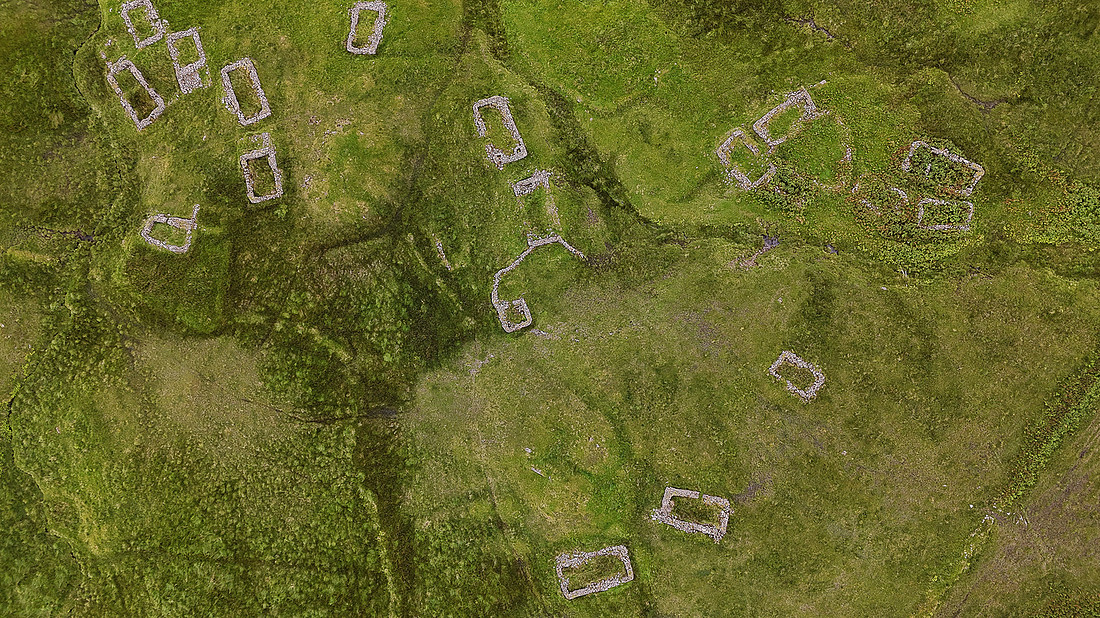
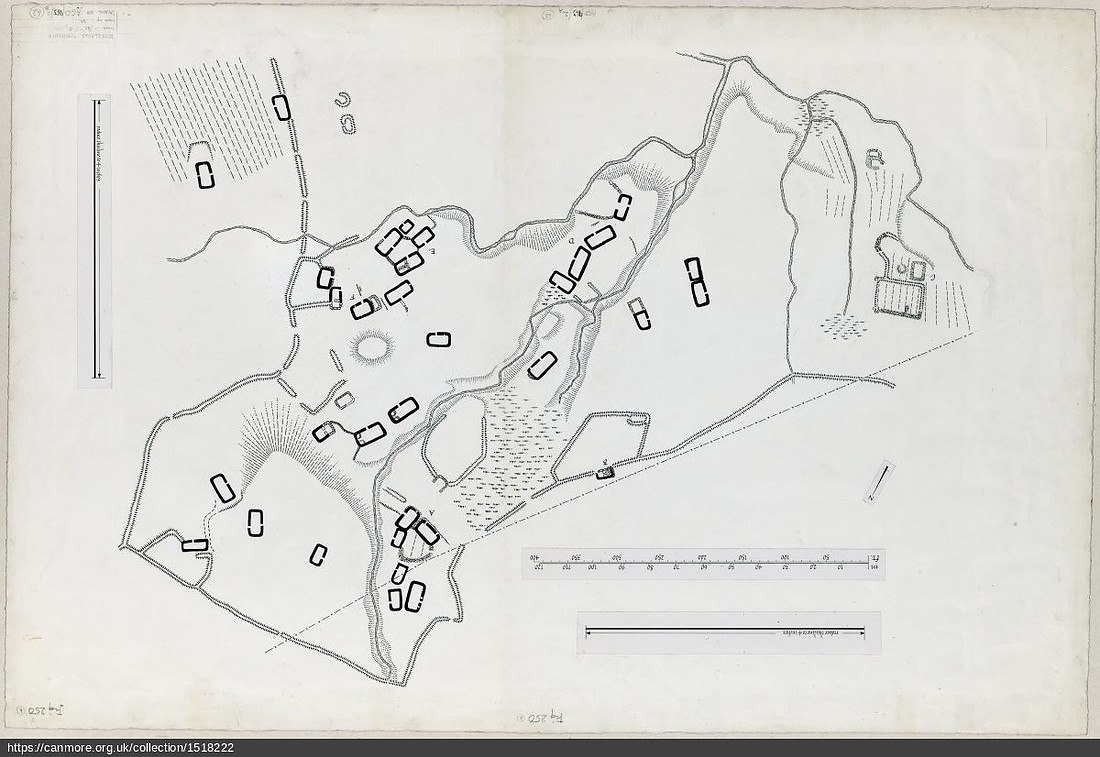 (© Crown Copyright: HES - Bourblaige settlement plan)
Geospatial interactive map of Bourblaige and the surrounding area HERE.
The place before the wound
Bourblaige does not begin in 1828. The settlement appears on an 1806 estate plan and in earlier records; HES notes suggest several phases of occupation, and the township likely goes back to medieval times, with documentary traces by 1541 and 17th‑century tenancies linking it to the MacIain lordship of Ardnamurchan. By 1737, local records put the population around thirty‑five; in 1807, surveyor Alexander Low described it tartly as “a very pleasant sheep farm oppressed with too many tenants.”
The village’s name carries memory too. Bourblaige is also recorded as Buarblaig (and earlier as Muribulg), a knot of etymology that has prompted both Gaelic and Norse readings. One recent synthesis points to Angus Henderson’s suggestion of a Norse compound—borg (fort) + bol (steading) + vik (bay)—fitting this landscape of farm, fort and shore. The same thread notes M. E. M. Donaldson’s early 20th‑century identification of Bourblaige/Muribulg with the 8th‑century battle of Muirbulg between Picts and Dál Riata—a suggestion repeated cautiously in archaeological registers. Whatever the philology, the place holds a palimpsest of speech and story.
The wide surround: Camas nan Geall and the long memory of things
If Bourblaige is a village in suspension, Camas nan Geall below it is a gallery of millennia. A Clyde‑type chambered cairn sits near the head of the bay; a Bronze Age standing stone bears a later cross-incision and an animal figure—signs of Christian overlay on older sacrality; a walled burial ground, Cladh Chiarain, gathers the graves of the Campbells of Ardslignish; on the headland, an Iron Age promontory fort keeps watch. It is an index of human time in one tight radius, with post‑clearance dwellings and township remains completing the arc
To stand at Bourblaige and look across to Camas nan Geall is to feel the thickening layers: Neolithic mortuary architecture; early Christian signs braided into pre‑Christian stones; clans and lordship; agricultural commoning; enclosure; and the sharp depopulation of the 1820s. The word heritage can be pallid; here it is immediate, embodied in walls, shells, and paths that continue to insist upon themselves.
A geology that underwrites mood
Ben Hiant’s geology frames this glen’s character. The mountain and its neighbouring hills expose a classic cross‑section of the Ardnamurchan igneous complex: agglomerate‑filled volcanic vents, ash, pitchstone and basic intrusions, with remnants of the early lava plateau overlaying Triassic sediment and Moine schist. On Hiant’s eastern slopes—north and south‑west of Bourblaige—the lavas and their spheroidal weathering make a high‑walled amphitheatre. The land’s dramatic geomorphology is not merely scenic; it structures the acoustics of the glen, the way wind and water collect and disperse sound, helping produce that receptive hush in which memory feels intensified.
Reading the plan with your feet
Because no later farmstead repurposed the stone, the township plan is legible underfoot. You can follow the burn where a horizontal mill may have turned, stand in the kiln‑barn’s mouth, step into a dwelling and feel the two‑room rhythm in your stride. The HES scheduling delineates not only the structures but an area around them “in which traces of activities associated with use and abandonment may survive”—which is to say, the ground itself is an archive: a community’s daily round, and the disorder of its forced departure.
Other sources map these features for the curious and the caring: local guides stress the two‑metre‑high walls, the grouped houses suggestive of seven or so family clusters, the cottar’s isolated steadings, the head‑dyke and rig marks on the infield. Together they describe a living economy of shared labour, not a mere clump of ruins.
Whose glen is this?
Bourblaige belonged to its people—in the sense of dùthchas, the inherited right to live and work one’s native ground, a principle never recognised in Scots law but central to Highland identity. The Clearances set dùthchas against the commercial logic of estates, and the law sided with the latter. In Ardnamurchan, as elsewhere, the turn to sheep and the calculus of rent drew a line that ran through hearths and human lives.
That line is visible still. It shows in the distribution of abandoned clachans on Ben Hiant’s skirts—Bourblaige, Tornamona, Coire‑mhuilinn and others named in the records. It shows in the fact that Bourblaige’s buildings “feel” so intact: there was no prolonged ebb of occupation, no patchwork of adaptation. The shock left the plan in one piece, like a dropped cup that somehow did not shatter.
The stones remember
“Silence is not absence, but presence,” one of my own field notes reads. In Bourblaige, silence is not the end of speech but the condition that lets other voices be heard. Local oral history, family names retrieved from Scotland’s People via heritage volunteers, and archaeological mapping combine into a chorus: Stewarts and Camerons; kail‑yards and rigs; a kiln where grain dried, a mill by the burn; seven family clusters, the cottar’s stead out on its own. The place keeps its names even when the paper trail thins
This is the sort of landscape David Paterson and David Craig sought to frame in The Glens of Silence: places where beauty does not cancel trauma but holds it in view; where photographic attention becomes an ethics of listening. Their work showed how a lens can keep faith with silence—not to aestheticise loss, but to let place be eloquent on its own terms.
A thin place
What, then, do we mean when we say that Bourblaige is thin? “Thin place,” in contemporary usage, isn’t doctrine but metaphor. It gestures toward heightened presence—toward moments and sites where distance collapses and attention is magnetised. Think of Iona, where centuries of prayer, exile and return have gathered into a dense quiet. Or think of Camas nan Geall’s layered sacrality. Thinness isn’t uniform; it’s a stance of attending, kneading experience and story together. In this sense, Bourblaige is a threshold: between the everyday and the remembered, the seen and the implied, the harm and the hope.
It is thin not because heaven is nearer here than elsewhere, but because the human is nearer—the human as it persists in the material world. In Bourblaige, the past is not behind you; it is beneath and around you. That is why the glen asks you to slow your breath, to walk the rigs like lines of a letter you’re learning to read.
Ekphrasis: through the lens
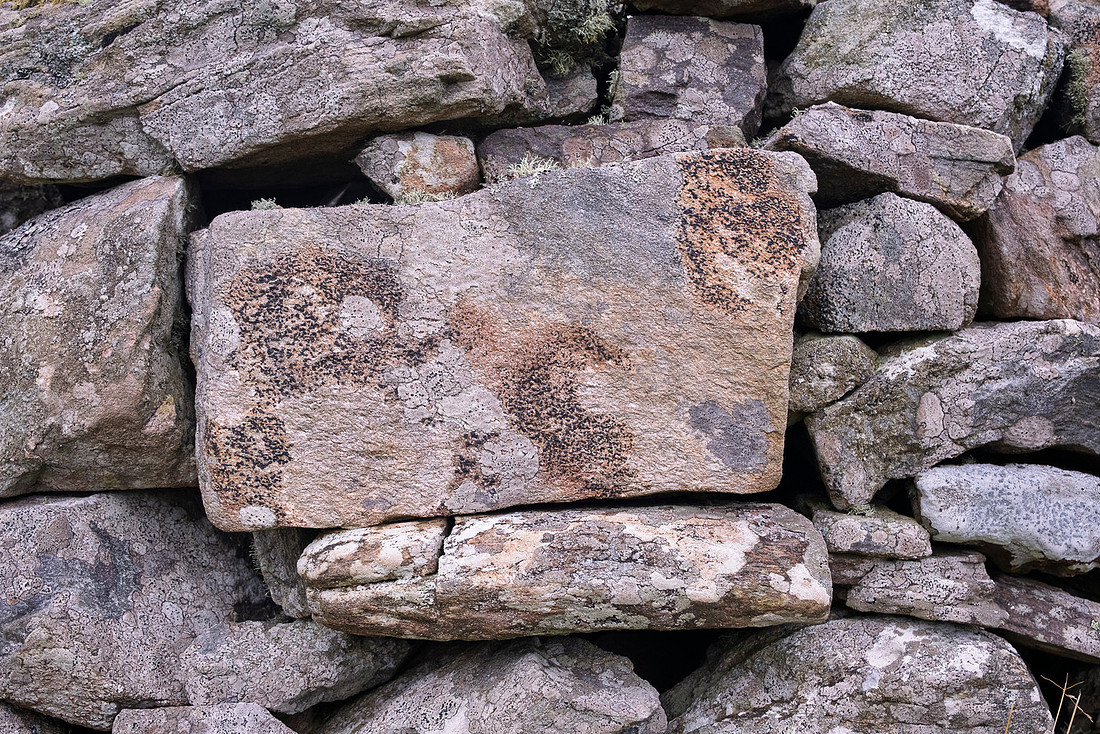
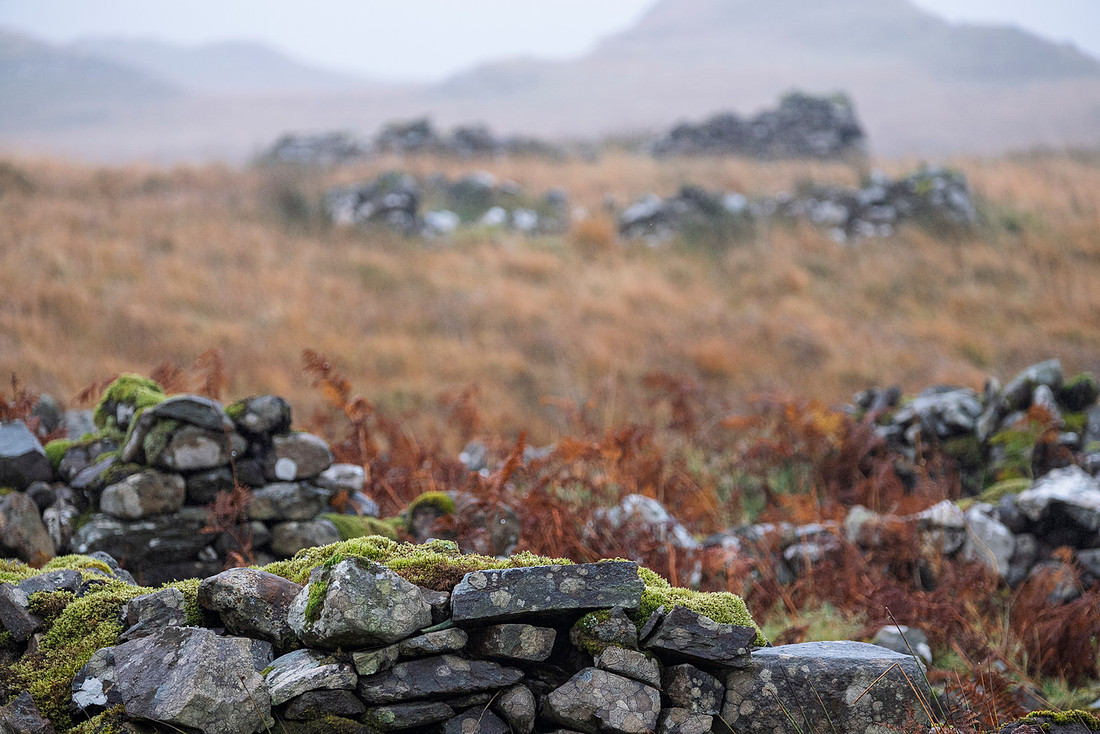
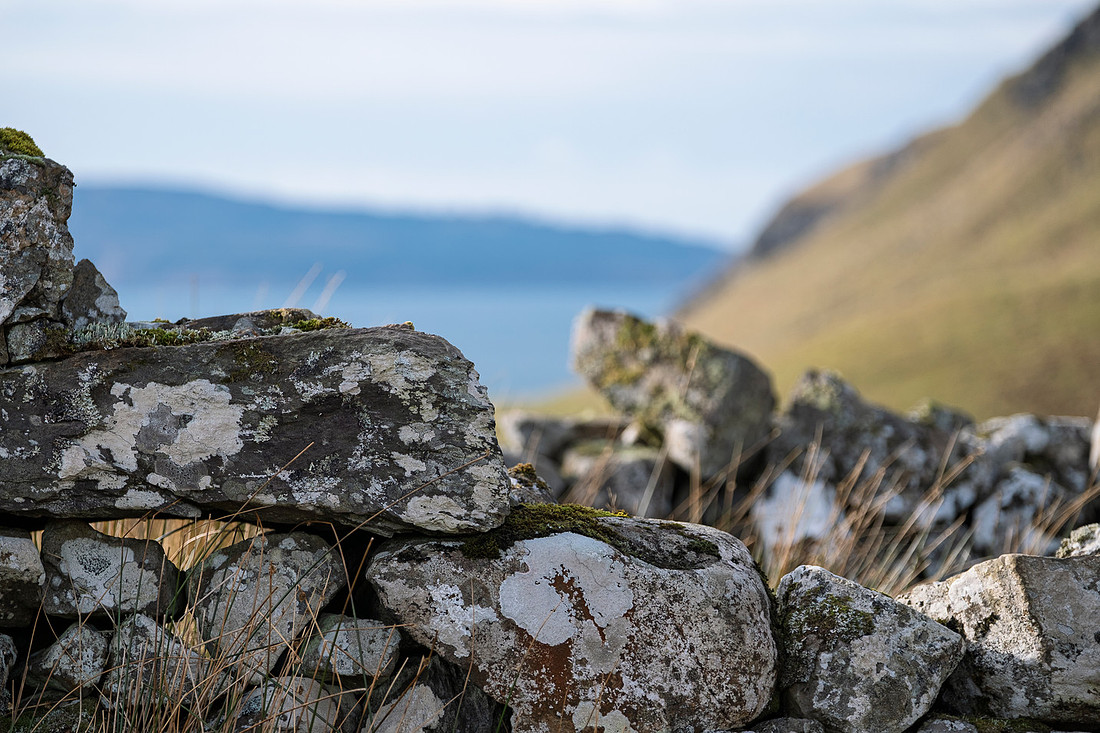
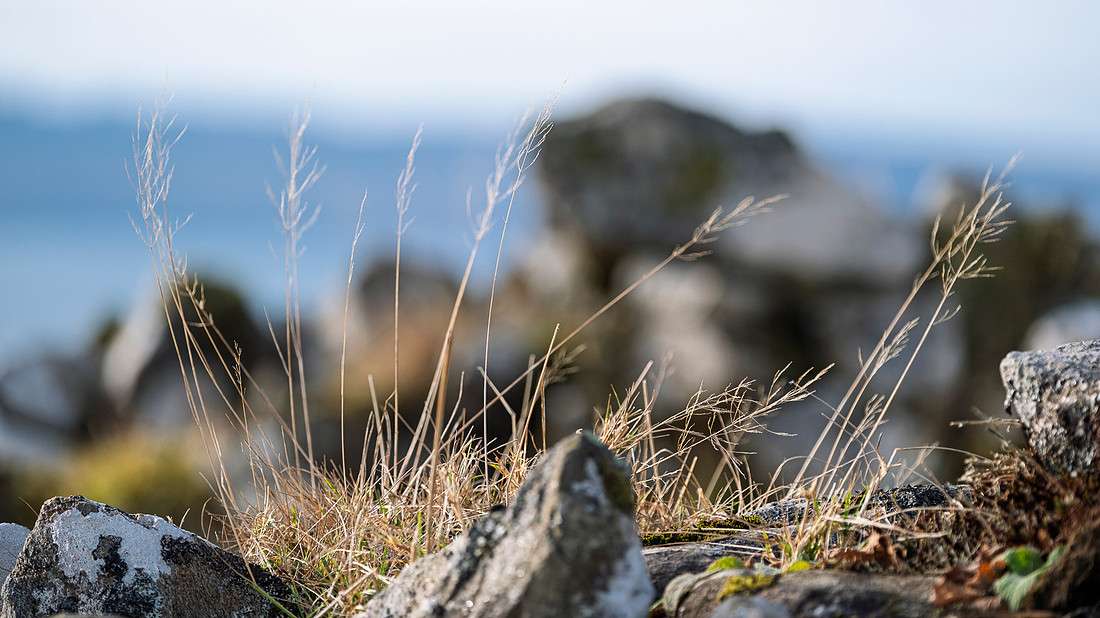
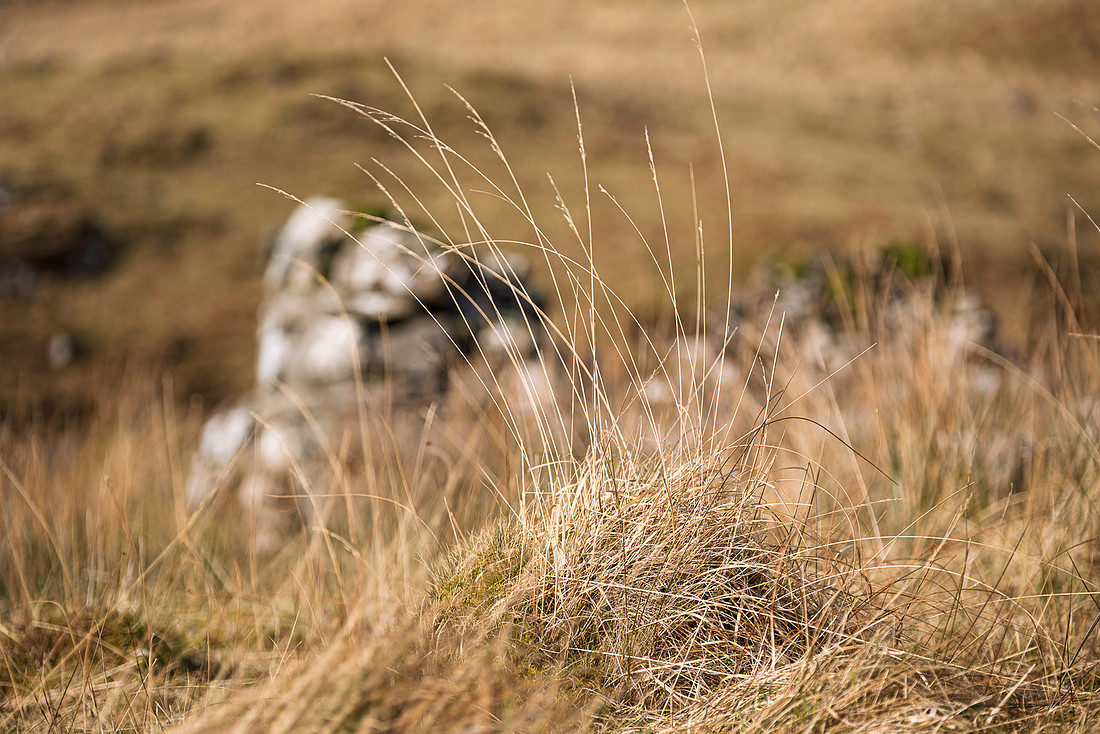
In the flatness of an overcast noon, the old walls carry a wet shine that makes their lichens star‑bright: ash‑grey colonies ringed by sulphur patch; copper glints where the stone remembers iron; a soldering of white snail shells caught in turf at the footings. On the leeward side of a longhouse, grasses kneel; on the windward, they speak in unison, long syllables, almost a chant. A threshold stone is worn concave where boots and bare feet chose the same edge over and over. The burn’s water is peaty tea, and where it pools you can see the sky fall into the earth, a bright ellipse among ribbed rushes.
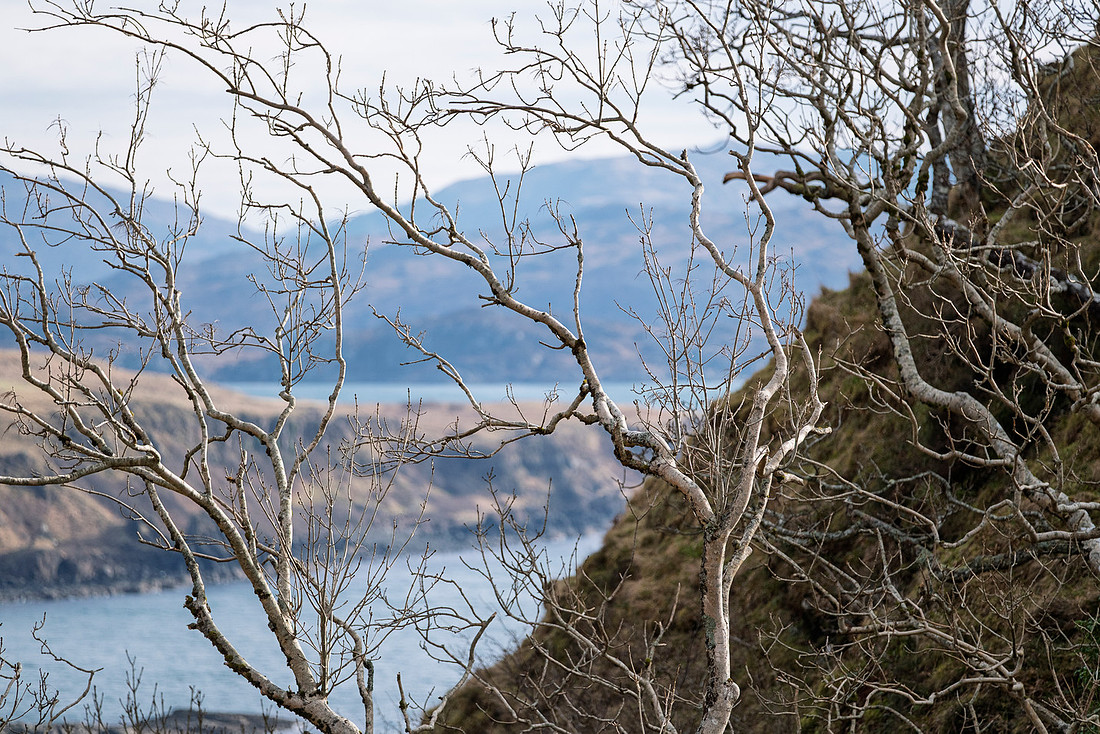
Lift the camera and the ruined gable makes a frame for Morvern; lower it and your eye learns the village’s grain. The lens teaches your walking, and your walking corrects the lens. The act of composing is not theft but gift‑exchange if it remains answerable to the glen—to its weather, its stories, its living memory. (There appears to be no re‑use of its stone, says the heritage survey; the phrase itself asks the photographer’s fidelity.)
The wound and the work
The Highland Clearances remain contested terrain in the national conversation—historians debate causes, degrees of agency and culpability, the inflections of famine and market. But Bourblaige writes its own affidavit. It does not argue; it shows. It shows how, in a single season, a living township can be turned to relic; how estate policy folds human futures into ledger lines; how language—clearance, improvement—can tidy violence into a gentler noun. If we are to be faithful witnesses, our work is to keep the particular in view: this glen, these families, this story of a woman barricaded in her home, this scorched timeline that left an intact plan without an intact people.
And it is to keep the wider field in sight: the first and second waves of clearance; assisted passages; the drift to Lowland towns and the diaspora; the eventual crofters’ legislation that answered protest too late for Bourblaige. The macrohistory does not erase the microhistory; it deepens the contrast, a darkroom in which the image of this place appears
Care as a form of belonging
Scheduling confers protection, but not immunity. Weather and stock continue the slow work of erasure. Local heritage groups and community historians have mapped walls and buildings, traced families, and gathered stories that enlarge the public archive—from the township’s medieval roots to the emigrant lists whispered through parish records. Such work matters not only for accuracy, but for care: it is how a community co‑owns its past, even when possession in law belonged elsewhere.
And care is what a thin place draws from us. We are not tourists of trauma. We are guests of the glen, arriving with clean boots and leaving with a little of its clay on our soles, a reminder that history is not an abstraction but something that clings.
Bourblaige in the series
Within Spiorad Àird nam Murchan, Bourblaige is a keystone: a settlement whose loss clarifies the stakes of presence elsewhere—on the coast path at Camas nan Geall; in the soundscape of wind over Hiant’s vents; in the community gardens far from here where continuities of care now root your days. The “spirit” in this series has never been disembodied; it is always tied to field and tide, to weld‑marks on a gate, to a dyke‑stone a winter frost has tipped. Bourblaige gathers those threads into a knot you can feel in your palm: grief at the severing; gratitude that the ground still speaks; resolve to keep listening.
Questions for reflection
- When you walk the rigs and foundations of Bourblaige, what do your feet learn that your eyes cannot?
- How might your photographs listen as well as look—what framings honour the glen’s silence without aestheticising its wound?
- Which stories feel most alive under the wind of Ben Hiant: those of kin and kail‑yards, of clearance and departure, or the deeper time of cairns and standing stones?
- If thinness is an ethical attention rather than a property of place, what practices—reading, walking, naming, tending—help you sustain it beyond the glen?
- Where in your own daily ground (garden, street, shoreline) do you sense similar thresholds, and how might Bourblaige teach you to keep them with care?
Sources and citations
Primary local and archaeological sources
- Historic Environment Scotland (HES). (1995; updated 2021) Bourblaige, settlement (SM6178). Available at: https://portal.historicenvironment.scot (Accessed 3 October 2025). [Bourblaige...t (SM6178)]
- National Record of the Historic Environment / Canmore. (n.d.) Ardnamurchan, Bourblaige (Canmore ID 22357). Available at: https://canmore.org.uk/site/22357/ardnamurchan-bourblaige (Accessed 3 October 2025). [Ardnamurch...- Canmore]
- Heritage Ardnamurchan. (n.d.) Bourblaige. Available at: https://heritageardnamurchan.co.uk/bourblaige/ (Accessed 3 October 2025). [Bourblaige...dnamurchan]
- Heritage Ardnamurchan. (2024) Bourblaige (interpretive print). Available at: https://heritageardnamurchan.co.uk/wp-content/uploads/2024/02/Bourblaige-Print-1.docx.pdf (Accessed 3 October 2025). [Bourblaige Print-1]
- Wild About Lochaber. (n.d.) Bourblaige (history) & Bourblaige Cleared Settlement (walk). Available at: https://www.wildlochaber.com (Accessed 3 October 2025). [Bourblaige...t Lochaber], [Bourblaige...an and ...]
- Wild Ardnamurchan. (n.d.) Bourblaige Cleared Village. Available at: https://www.wildardnamurchan.com/history/bourblaige-cleared-village (Accessed 3 October 2025). [Ardnamurch...ed Village]
- Ardnamurchan History and Heritage Association. (n.d.) Bourblaig families at the time of the clearances. [PDF] Available at: https://heritageardnamurchan.co.uk/wp-content/uploads/2020/01/BOURBLAIG-FAMILIES-at-the-TIME-of-the-CLEARANCES.pdf (Accessed 3 October 2025). [BOURBLAIG...dnamurchan]
- Clan MacIain of Ardnamurchan. (2015) Bourblaige. Available at: http://www.clanmaciain.com/maciain/bourblaige/ (Accessed 3 October 2025). [Bourblaige...dnamurchan]
- JNCC. (n.d.) GCR site account 10: Ben Hiant. Available at: https://jncc.gov.uk (Accessed 3 October 2025). [GCR site a...ncc.gov.uk]
- Trove.scot / HES data. (n.d.) Ardnamurchan, Bourblaige / Muribulg (place record). Available at: https://www.trove.scot/place/22357 (Accessed 3 October 2025). [Ardnamurch...trove.scot]
Contextual and neighbouring sites
- Heritage Ardnamurchan. (n.d.) Camas nan Geall. Available at: https://heritageardnamurchan.co.uk/camas-nan-geall/ (Accessed 3 October 2025). [Camas nan...dnamurchan]
- Wild Ardnamurchan. (n.d.) Camas nan Geall (Historical Attraction). Available at: https://www.wildardnamurchan.com/history/camas-nan-geall (Accessed 3 October 2025). [Ardnamurch...nan Geall]
Highland Clearances: general background
- Scottish History Society. (n.d.) The Highland Clearances (brief account). Available at: https://scottishhistorysociety.com (Accessed 3 October 2025). [The Highla...ry Society]
- Wikipedia. (n.d.) Highland Clearances. Available at: https://en.wikipedia.org/wiki/Highland_Clearances (Accessed 3 October 2025). (Used for general definitions and chronology; corroborated against SHS.) [Highland C...Wikipedia]
Thin places (conceptual framing)
- Young, R. (2021) ‘Thin places — Here, there or everywhere?’ Presbyterian Outlook. Available at: https://pres-outlook.org (Accessed 3 October 2025). [Thin place...an Outlook]
- Roberts, M. D. (2012) ‘Thin Places: An Introduction.’ Patheos. Available at: https://www.patheos.com (Accessed 3 October 2025). [Thin Place...- Patheos]
Book
- Paterson, D. & Craig, D. (2004) The Glens of Silence: The Landscapes of the Highland Clearances. Edinburgh: Birlinn. (Publication details verified via publisher listings and booksellers.) [The Glens...s: The ...]
Own source materials (consulted for imagery, phrasing, and local tradition references)
- Knight, R. (n.d.) Bourblaige: The Glen That Remembers. [Unpublished draft essay] (consulted as “Bourblaige_The_Glen_That_Remembers.docx”). [Bourblaige..._Remembers]
- Knight, R. (n.d.) The Stones Remember: Bourblaige and the Echoes of Ardnamurchan. [Unpublished draft essay] (consulted as “The_Stones_Remember_Bourblaige - LF.docx”). [The_Stones...laige - LF]
- Knight, R. (n.d.) Bourblaige: Historical Context (Ref document). [Working notes] (consulted as “Bourblaige_Historical_Context Ref Document.docx”). [Bourblaige...f Document]
Notes on verification: Dates, designations, site extent and building counts were cross‑checked against HES (SM6178) and Canmore; location, access and descriptive summaries were corroborated via Wild About Lochaber and Wild Ardnamurchan; population and clearance details (including the 1828 date and the Alexander Low quotation) were taken from Heritage Ardnamurchan, which cites primary estate materials; family names and post‑clearance traces were checked against the Heritage Ardnamurchan families PDF; the “barricaded woman” account and the “factor’s grave” tradition are reported on Heritage Ardnamurchan and echoed in user‑provided drafts; geological context is from the JNCC GCR site account for Ben Hiant. [Bourblaige...t (SM6178)], [Ardnamurch...- Canmore], [Bourblaige...t Lochaber], [Ardnamurch...ed Village], [Bourblaige...dnamurchan], [BOURBLAIG...dnamurchan], [GCR site a...ncc.gov.uk]
Comments
I feel the sadness is compounded by the fact that the farmer who occupied the farm only stayed 11 years! Quite a sad conclusion to what was once a thriving fertile community.